
 By
By The issue of implementing a caste-based census in India is embroiled with complexities. Outdating colonial considerations to present-day politics, social equality frameworks, and economic policy, the discussion around a caste based census invokes questions of identity, representation, and what role the state must play to mitigate inequality. For a diverse nation like India understanding the caste composition of society is important but contentious.
Historical Background of Caste Census in India
Colonial Era Beginnings
- As early as 1871, the British colonial government began incorporating the caste system into India’s census classification systems.
- In 1931, India conducted its last detailed caste census, which contained rich information about a vast number of castes and sub-castes present in India.
- Post independence, the collection of SCs and STs data has been continued till today in India.
Post-Independence Period
- Constitutionally speaking, ‘Untouchability’ was removed under Article 17 but granted affirmative recognition stating that caste remains pertinent for socio-economic disparity.
- Caste continues to relate importance towards reservation policies as well as affirmative action programs.
What is Caste Census?
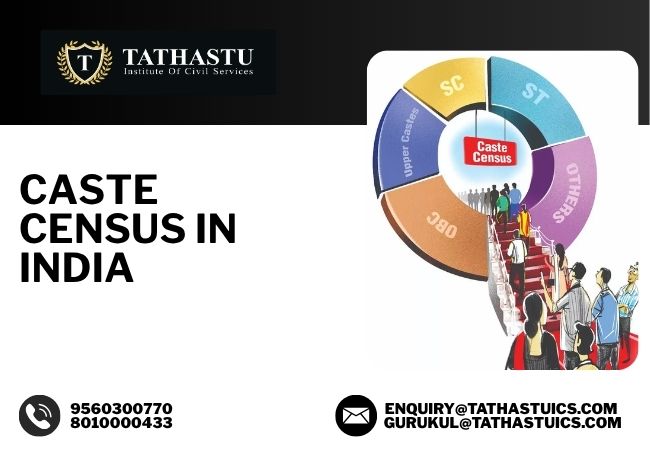
- A Caste Census is the systematic collection of data pertaining to various castes, sub castes and communities present in India and not limited to only Scheduled Castes or Scheduled Tribes.
- This information can serve several purposes:
- To comprehend the demographic distribution,
- To devise welfare programs that are more focused,
- To evaluate and modify the reservation system,
- To accurately mitigate socio-economic disparities.
Supporting Arguments for Caste Census in India
The supporting arguments for a caste census would include:
- Caste stratification broadly determines an individual’s access to education, employment opportunities, healthcare services, as well as land ownership.
- Having comprehensive data will make it possible for the government to formulate targeted policies and welfare programs based on need.
- Updating outdated information, estimates of its OBC population put out by the NPR are based on a census taken over 90 years ago.
- With current data being necessary to either uphold or alter certain reservations and quotas makes this highly relevant.
- Social equity can showcase disproportionate intra-caste gaps that go unseen among lower castes or ignored sub castes, which need funding reallocated to their benefits, redistributing amongst backward classes, thus framing equity.
- Utilizing updated caste-based information allows creating political boundaries for constituencies alongside politically reserved seats like panchayats, enabling optimal utilisation of resources.
Counter Arguments on Caste Census in India
- Risk of Division and Polarization
-
-
- Identity politics and social fragmentation may worsen due to caste enumeration.
- There is worry that reinforcing caste identities may set us back in our efforts towards forming a society where distinctions based on caste are abolished.
-
- Administrative and Methodological Concerns
-
-
- The Indian caste system encapsulates thousands of sub-castes, which makes it fluid and localised.
- The complexities surrounding data collection would lead to great difficulty in classification, resulting in inaccuracies, disputes, and other conflicts.
-
- Political Exploitation Concerns
-
-
- Critics suggest that the data may be used for short-term electoral campaigns focused on vote banks.
-
- Inconsistency with Equality Principles
-
- Focusing on the existence of castes is contradictory to the constitutional aim towards a casteless society. This has been supported by some people.
- Security and privacy concerns highlight the potential exploitation or incitement of communal violence provoked by sensitive information relating to castes.
Political Consequences of Caste Census in India
-
- Central Government’s Position
- The central government of India focuses primarily on opposing the census beyond SCs and STs due to the administrative burden claim, alongside technical hurdles framing it as an obstacle.
- Central Government’s Position
- Supreme Court’s Involvement
-
- Legal challenges have arisen concerning the legality and usefulness of such surveys.
Socio-Economic Consequences of Caste Census in India
- Individual Welfare Initiative Improvement
-
- We can reassess the welfare programs being advanced by analysing the caste groups in a particular socio-economic class, wealth, land and resource level using the comprehensive census.
- Changes to Reservation Policies
- The outcome will either nullify established quotas or justify their persistence, resulting in policy changes.
- Caste and Private Employment Sectors
- With growing interest in reservations for private employment, it will influence debates relating to caste, which is increasingly gaining attention.
- Public Reactions and Civilian Societies
- Activists perceiving the Bahujan and Dalit rights, ignoring the civil society claims, armed with rational arguments, strongly believe this is an empowering strategy towards the caste census.
- International Differences
- While many other countries, such as the USA and UK, are collecting race and ethnicity data for affirmative action strategies, unlike India.
- This serves as justification, as seeking information centred around identity can be used as a basis to offset inequality that is deeply rooted within social system structures.
Way Ahead
- Clear Methodology
-
-
- Any caste census should be executed with well-defined parameters, expert input, and standardised categorisation methods.
-
- Protection of Data Privacy
-
-
- Legal measures must be established to safeguard citizens’ privacy.
-
- Inclusive Socio-Economic Mapping
-
-
- To integrate caste information with additional indicators such as income, education, and landholding for a clearer understanding.
-
- Unbiased Oversight
-
- To establish a non-partisan body to analyse and disclose findings, preventing political exploitation.
Conclusion
The caste census represents more than a mere bureaucratic task; it reflects India’s societal realities. In a country seeking equity hampered by centuries of division, caste data could act as a foundation for inclusive progress. Nevertheless, it needs to be approached with caution, neutrality, and intent to prevent exacerbating divisions.