
 By
By Earth is surrounded by a vast layer of air known as the atmosphere. Living beings need the atmospheric blanket to survive, and it protects us from dangerous sunlight rays. Earth would be uninhabitable without this protective atmospheric layer. Due to its vital function, the atmosphere maintains an optimal planet temperature that allows living organisms to survive.
Composition of Atmosphere
- The atmosphere consists of a mixture of several gases instead of being a single unified gas.
- The atmosphere consists mainly of nitrogen (78%), while oxygen (21%) forms its second largest composition.
- The atmosphere contains lower amounts of carbon dioxide as well as helium alongside ozone and argon, and hydrogen gases.
Nitrogen
- Human beings, along with animals, breathe nitrogen as it remains the dominant and most abundant gas component in the atmosphere.
- However, plants do not have the ability to extract nitrogen from atmospheric air directly.
- Soil bacteria together with bacteria inside plant roots transform atmospheric nitrogen into a usable form which plants require to thrive.
Oxygen
- Oxygen is the second most abundant atmospheric gas, which is essential for the existence of human beings and other animals.
- Photosynthetic green plants generate oxygen through the process of photosynthesis, which sustains atmospheric equilibrium.
- Deforestation, one such cause that disrupts the natural equilibrium, reducing oxygen levels.
Carbon Dioxide
- Plants require Carbon Dioxide (CO2) for photosynthesis since they convert it into food products, which release oxygen.
- Both humans and animals naturally exhale carbon dioxide gas to create and maintain an equilibrium in the environment.
- Global warming and climate change have increased significantly due to the high amount of CO2 in the atmosphere caused by the burning of fossil fuels such as coal and oil.
Structure of Atmosphere
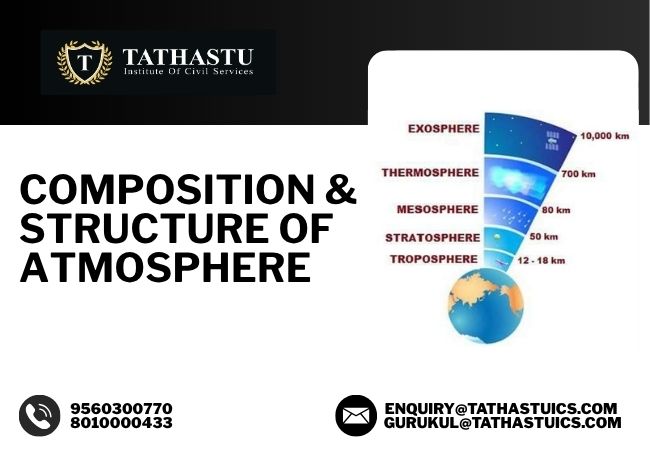
The atmosphere contains five layers, which differ in their characteristics across the vertical expanse:
- Troposphere- The troposphere is the lowest layer that extends up to 13 kilometres from the Earth’s surface, where it produces weather elements such as rainstorms, fog and thunderstorms.
- We all breathe in this air (troposphere).
- Stratosphere- The stratosphere layer that lies just above the troposphere at an altitude of 50 kilometres above Earth’s surface.
- This layer is ideal for the aircraft and has a protective ozone layer to protect us from harmful ultraviolet rays.
- Mesosphere- The mesosphere layer extends up to 80 km from the Earth’s surface, where most meteorites succumb to atmospheric heat when they enter the Earth’s atmosphere.
- Thermosphere- The Thermosphere extends vertically from ground level to 400 km, where it displays a strong temperature rise with altitude growth.
- The ionosphere, a part of this layer, helps in radio wave communication to reflect radio signals back towards the Earth.
- Exosphere- The exosphere layer is the outermost layer that extends to space, where the atmosphere becomes increasingly thin.
- Helium and hydrogen light gases escape into the void of space at this altitude.
Weather and Climate
Weather refers to the short-term atmospheric conditions such as temperature, humidity and precipitation patterns that change on an hourly and daily basis. Climate refers to the average weather patterns of particular geographic regions over a long period of time. Weather determines our day-to-day physical activities of life, whereas, climate shapes the entire environmental conditions of any place.
- Temperature: The thermal conditions of the air shift from warm to cold as days advance and through seasonal changes.
- The distribution of temperatures in a region depends on incoming solar energy, also known as insolation.
- The equatorial region receives more solar energy than at the polar regions, which leads to hotter temperatures in equatorial regions.
- Air Pressure: Air exerts pressure on the Earth’s surface, but we don’t feel it because our bodies exert an equal counter pressure.
- Air pressure decreases with altitude and is influenced by temperature.
- High-pressure areas are associated with clear skies, while low-pressure areas bring cloudy and wet weather.
- Wind: The movement of air from high-pressure to low-pressure areas creates wind.
- Winds can be permanent (e.g., trade winds), seasonal (e.g., monsoons), or local (e.g., land and sea breezes).
Moisture & Precipitation
The natural process of water loss from land surfaces and water bodies produces water vapor within atmospheric regions. The air reaches saturation level which leads to vapor condensation resulting in water drop formation that becomes clouds. The heavy burden of water droplets causes them to drop from the air as precipitation in the forms of rain, snow or hail.
Types of Rainfall
- Convectional Rainfall: Warm air that ascends and cools down, and condenses, results in convectional rainfall.
- Orographic Rainfall: When moist air rises over the mountains, the air cools down, condenses it results in orographic rainfall.
- Cyclonic Rainfall: The cyclonic rainfall forms during cyclonic and low-pressure conditions.
Conclusion
The atmosphere is a complex and dynamic system that sustains life on Earth. Its composition, structure, and processes regulate temperature, weather, and climate. Human activities, such as deforestation and burning fossil fuels, are disrupting the delicate balance of the atmosphere, leading to global warming and climate change. Understanding and protecting our atmosphere is essential for ensuring a sustainable future for all living beings.